

- House Plant Sitting
- June 18, 2026
- News
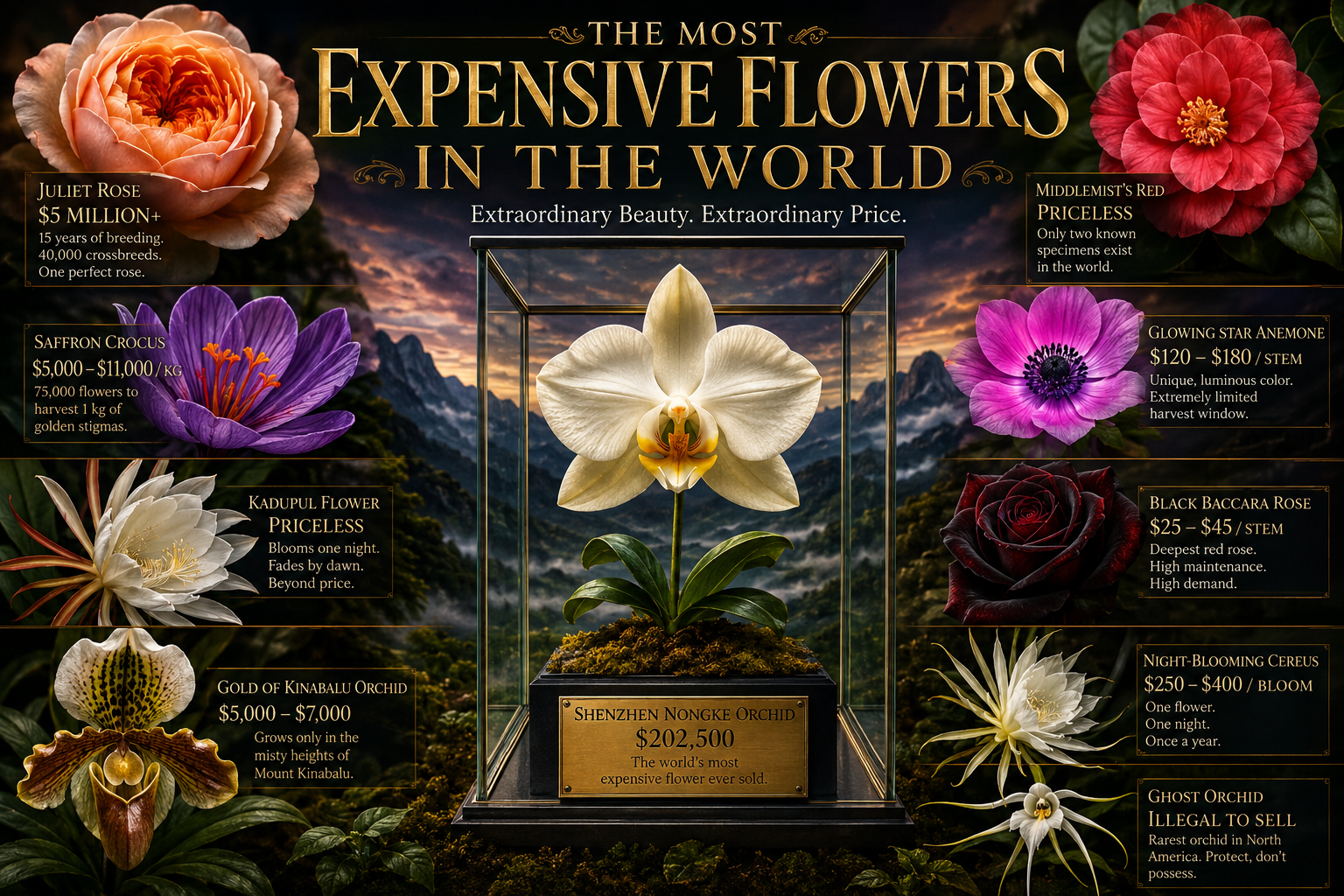
The Most Expensive Flowers in the World
The Most Expensive Flowers in the World: Proof That Plants Have Better Financial Advisors Than We Do
There comes a point in every gardener’s life when they walk through a garden center, look at a $12 potted plant, and think:
"Twelve dollars? For a plant?" Then they buy it anyway.
This is because gardeners operate under a unique financial system where spending money on plants does not count as spending money. It counts as "investing in beauty," which is what we tell ourselves while loading our sixth pothos into the shopping cart.
But even the most enthusiastic plant lover would likely pause before purchasing a flower that costs more than a luxury sports car. Or a house. Or, in one case, several houses.
Believe it or not, some flowers command prices so high that they make diamond dealers look reasonable. And while it would be easy to assume these flowers are simply very pretty, that's not actually why they cost so much.
After all, if beauty alone determined value, every gardener would be a millionaire by July.
The real reasons certain flowers become extraordinarily expensive involve a fascinating combination of science, scarcity, human obsession, labor, and what appears to be a collective willingness among some wealthy people to spend enormous sums on things that eventually wilt.
Let's take a tour through the world's most expensive flowers and discover why these botanical celebrities cost more than many people's retirement accounts.
Why Some Flowers Cost More Than Your Car
Most people assume expensive flowers are simply rare. That's part of the story. But rarity alone doesn't explain why one flower costs $5 and another costs $200,000.
If that were true, my ability to keep a fern alive would be considered rare, and I'd be charging admission.
The reality is that flower prices are driven by a strange mix of factors:
Years of breeding and research
Extreme labor requirements
Difficult growing conditions
Legal restrictions
Cultural significance
Human beings deciding they absolutely must own something because other people can't
That last factor explains much of human history.
In the flower world, these forces combine to create some truly astonishing prices. And at the very top sits a flower that most people have never heard of.
The Shenzhen Nongke Orchid: The $202,500 Flower
Imagine spending eight years developing a flower. Not admiring a flower. Developing one.
Scientists in China did exactly that.
The result was the Shenzhen Nongke Orchid, a laboratory-created orchid that eventually sold at auction for an eye-watering $202,500. For a single plant. At that price, the buyer could have purchased a house, a sports car, or enough potting soil to bury a small town.
What made this orchid so valuable? Unlike naturally occurring orchids, it was created through years of research, hybridization, and tissue culture. Only a tiny number existed, and every specimen was essentially a clone.
In other words, if orchids had celebrity status, this was the botanical equivalent of a limited-edition rock star.
The remarkable thing is that most people would probably walk past it in a garden center without realizing it was worth more than their mortgage. Which just proves that plants don't care about our economic systems.
The Juliet Rose: A Flower Worth Millions
Roses have always enjoyed a reputation for elegance. They're romantic. They're timeless. They're also responsible for approximately 87% of Valentine's Day panic.
But one rose stands above the rest in terms of cost. The Juliet Rose took legendary rose breeder David Austin fifteen years and roughly 40,000 breeding attempts to perfect.
Think about that. Forty thousand attempts. Most of us give up assembling furniture after three.
The development costs reportedly exceeded $15 million, making it one of the most expensive flower-breeding projects ever undertaken. The rose itself is beautiful, with soft apricot-colored blooms and a fragrance that seems specifically designed to convince gardeners they need just one more rose bush.
Of course, gardeners know there is no such thing as "one more rose bush."
Saffron Crocus: The Flower That Became a Luxury Spice
Some flowers are valuable because they're rare. Others are valuable because harvesting them is essentially an endurance sport. Meet the saffron crocus.
This flower produces saffron, one of the most expensive spices on Earth. The reason is simple.
Each flower produces only three tiny stigmas. Three.
To produce a single kilogram of saffron requires tens of thousands of flowers and countless hours of hand harvesting.
Imagine being assigned the job of collecting tiny flower parts from 75,000 blooms before breakfast.
At some point you'd begin questioning your life choices.
This intense labor requirement is why saffron often sells for thousands of dollars per kilogram and why recipes calling for saffron should be approached with the same seriousness as recipes calling for gold.
The Kadupul Flower: The Flower Money Can't Buy
Now we arrive at perhaps the most fascinating flower on this list. The Kadupul Flower.
This flower blooms only at night and begins fading before sunrise. Its bloom is so brief and delicate that it cannot realistically be harvested, transported, or sold. In other words, it completely ignores capitalism.
Imagine telling a marketing executive:
"We've developed a beautiful product."
"Great! How long does it last?"
"About six hours."
"And can customers buy it?"
"Not really."
The Kadupul Flower is considered priceless not because it's expensive, but because ownership is practically impossible. Its value comes from experiencing it. Which is a surprisingly profound lesson from a plant.
The Gold of Kinabalu Orchid: The Orchid That Refuses to Be Easy
Some flowers grow almost anywhere. Dandelions, for example, could likely survive a meteor strike. The Gold of Kinabalu Orchid has chosen a different lifestyle.
This orchid grows naturally only in specific areas of Mount Kinabalu in Borneo and takes years to mature. It has highly specific environmental requirements and a tendency to punish mistakes. This combination of rarity and difficulty has made mature specimens worth thousands of dollars.
Many gardeners dream of growing one. Many gardeners also dream of winning the lottery. Statistically, both pursuits require optimism.
Middlemist's Red: Rarer Than Rare
There are rare flowers. Then there's Middlemist's Red. Only two known specimens exist in the entire world.
Two.
That's not a typo. Two. At this point, we're no longer discussing gardening. We're discussing witness protection for plants.
Originally brought from China to England in the early 1800s, the flower disappeared from its native habitat and now survives only in a pair of cultivated specimens.If flowers had social media accounts, Middlemist's Red would have approximately two followers. And both would be itself.
The Black Baccara Rose: The Goth Rose
Every flower garden eventually needs a rebel. Enter the Black Baccara Rose. This rose isn't actually black.
It's an extraordinarily deep shade of red that appears black under certain lighting conditions.
Which makes it the flower equivalent of that friend who insists they're mysterious despite posting their entire life online.
Demand for these roses skyrockets around holidays and special occasions because people love unusual flowers. Growers, meanwhile, must carefully manage disease, humidity, temperature, and handling to produce market-quality stems.
The result is a flower that commands premium prices while making gardeners feel slightly cooler just by growing it.
The Night-Blooming Cereus: Nature's One-Night Performance
Some flowers bloom for weeks. The Night-Blooming Cereus has no interest in such commitments. This spectacular cactus flower opens for a single night each year. One night.
Miss it and you'll spend the next eleven months explaining to people that, yes, it really did bloom and no, you didn't get a photo because you were asleep. When it does bloom, the display is magnificent. Large white flowers emerge dramatically in the darkness before fading by morning.
It's basically the Broadway production of the plant world. A very short Broadway production.
The Ghost Orchid: The Plant World's Celebrity Fugitive
The Ghost Orchid may be one of the most famous orchids in North America.
Native to parts of Florida and the Caribbean, it appears to float in midair because its leaves are nearly nonexistent. Instead, it photosynthesizes through its roots. Which sounds less like a flower and more like something invented by science fiction writers.
Its rarity, beauty, and conservation status have made it legendary among orchid enthusiasts.
It's also heavily protected. Which means if you find one in the wild, the correct response is admiration.
Not shopping.
What These Expensive Flowers Teach Gardeners
The funny thing about expensive flowers is that most gardeners don't actually want them.
Or at least they don't want the responsibility that comes with them.
Many of the world's most valuable flowers are notoriously difficult to grow.
Some bloom briefly.
Some take years to mature.
Some require conditions so specific that maintaining them resembles running a laboratory.
Meanwhile, a cheerful marigold costing less than a cup of coffee will happily bloom all summer while asking almost nothing in return.
This is one of gardening's greatest lessons.
Price and enjoyment are not the same thing.
A flower worth $200,000 may impress auction bidders.
A sunflower grown from a packet of seeds can make you smile every morning for months.
And the sunflower doesn't require a security system.
Why Gardeners Keep Chasing Rare Flowers
Despite all of this, gardeners remain fascinated by rare and expensive blooms.
Part of it is curiosity.
Part of it is appreciation for the incredible work involved in creating these plants.
And part of it is the same instinct that causes people to stop and stare at exotic cars they'll never buy.
We like extraordinary things.
Flowers happen to be extraordinary things that occasionally attract bees instead of paparazzi.
The world's most expensive flowers remind us how much effort, patience, science, and passion can be invested in something as seemingly simple as a bloom.
They also remind us that beauty comes in many forms.
Sometimes it's a laboratory-created orchid worth hundreds of thousands of dollars.
Sometimes it's a rare rose developed over fifteen years.
And sometimes it's the volunteer zinnia that unexpectedly appears in your garden because last year's flowers dropped a few seeds and decided to surprise you.
The truth is that most gardeners already own something more valuable than the world's most expensive flower.
They own the experience of watching something grow.
No auction house can sell that.
And no amount of money can improve the feeling of walking into the garden one morning and discovering a bloom that wasn't there yesterday.
Although if somebody wants to offer $202,500 for my hydrangea, I am willing to negotiate.
Share on