


- House Plant Sitting
- December 28, 2025
- News
Why Snowbirds Need Plant Sitters
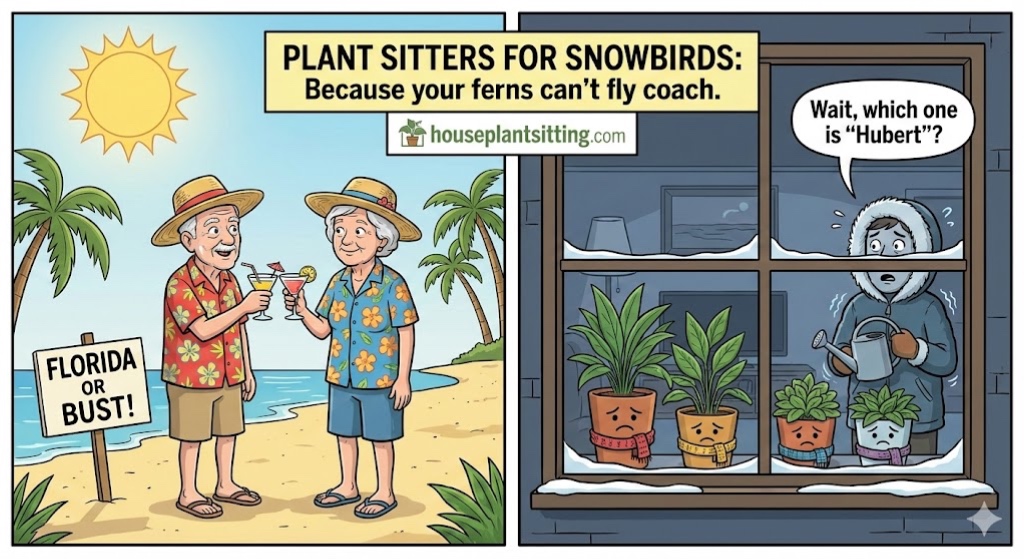
Every year, right about the time the weather forecast starts using words like “polar vortex” and “historic regret,” a magical migration occurs. No, not geese. Geese have wings and confidence.
We’re talking about snowbirds—otherwise reasonable humans who suddenly decide that owning a house in a place where the air hurts their face is optional. These brave souls pack up their flip-flops, sunglasses, and suspiciously loud vacation shirts, and head south for warmer climates, better sunsets, and the chance to say things like, “Well, back home it’s snowing,” to strangers who did not ask.
But here’s the thing snowbirds often forget:
They are not leaving alone.
They are leaving behind houseplants.
And houseplants, as science has proven* (by which we mean observation and mild panic), do not like being abandoned for three to six months with nothing but a neighbor who “waters occasionally” and a vague sense of betrayal.
This is where plant sitters for snowbirds enter the story, wearing metaphorical capes and holding watering cans like instruments of peace.
The Secret Emotional Life of Houseplants 🌴
Houseplants look calm. They sit there quietly, photosynthesizing, minding their own business, pretending they don’t have strong opinions.
This is a lie.
Houseplants are deeply emotional creatures. They notice everything.
They notice:
When you move them closer to the window and then immediately move them back because “the light felt aggressive.”
When you forget to water them and then dramatically overcorrect by flooding them like a biblical event.
When you leave for Florida without so much as a goodbye.
To a houseplant, your departure looks like this:
“Oh. I see. You’re taking the suitcase. That’s fine. I’ll just… stay here. With the radiator.And the darkness.”
Plants may not scream, but they definitely wilt with intention.
Why Snowbirds Need Plant Sitters (And Not Just “Someone to Check In”) ✈️
Many snowbirds begin their winter escape with optimism.
They say things like:
“The plants will be fine.”
“I’ll leave instructions.”
“My neighbor said they’d pop in.”
These are the same people who once said:
“I don’t need to back up my computer.”
“I’ll remember that password.”
“This pothole doesn’t look that deep.”
Let’s talk about neighbors.
Neighbors are wonderful people. They mean well. But neighbors have lives. They have their own plants, their own schedules, and their own unique interpretation of the phrase “once a week.” Also, neighbors often believe that all plants are the same plant.
To them:
A cactus is basically a fern with confidence.
An orchid is “just dramatic.”
A fiddle leaf fig is “probably fake.”
A professional plant sitter for snowbirds, on the other hand, understands that:
Overwatering is not kindness.
Underwatering is not discipline.
Talking to plants is optional but encouraged.
What Exactly Does a Plant Sitter Do? 🪴
This is an excellent question, usually asked by someone whose last plant died “for no reason at all.” A plant sitter does much more than pour water and leave.
A plant sitter:
Checks soil moisture like a responsible adult.
Rotates plants so they don’t grow sideways in despair.
Notices early signs of pests, disease, or existential dread.
Adjusts care based on weather, light changes, and plant mood swings.
Makes sure your plants are still alive when you return, which is the main goal.
Think of a plant sitter as:
A babysitter, but quieter.
A houseguest, but without using your towels.
A therapist, but for leaves.
Snowbirds and the Long Goodbye (From Plants Who Didn’t Sign Up for This) 🐦❄️
Snowbirds often leave for months. Not days. Not weeks. Months.
To a plant, this is an eternity.
Imagine if someone said to you:
“I’ll be back in March. Try not to change too much.”
Plants change constantly. They grow. They rest. They shed leaves out of spite. Without proper care, plants don’t just decline—they stage a slow, leafy protest.
First, a leaf turns yellow. Then another. Then suddenly the plant looks like it has read too much bad news.
A plant sitter prevents this downward spiral by showing up regularly and saying, in plant language:
“You are not alone. Someone still cares. Please don’t drop all your leaves.”
Why Houseplantsitting.com Exists (And Why Your Plants Approve) 🌵
At houseplantsitting.com, the idea is simple:
Plants deserve better than hope. Hope is not a care plan. Hope does not check soil moisture. Hope does not know the difference between indirect light and “that one window that looks bright but lies.”
Professional plant sitters understand that:
Each plant has unique needs.
Each home has unique conditions.
Each snowbird wants to come back to a house that doesn’t look like a botanical crime scene.
Houseplantsitting.com connects plant owners—especially snowbirds—with people who actually know what they’re doing. Which is refreshing.
Common Snowbird Plant Disasters (A Short, Painful List) 📝
Let’s review a few scenarios that plant sitters regularly rescue plants from:
1. The Overwaterer
Someone decides plants need water every time they visit. The plant drowns quietly, like a polite British person.
2. The Forgetter
Someone forgets for three weeks, then waters aggressively out of guilt. The plant experiences emotional whiplash.
3. The Sun Mover
Someone moves a low-light plant into direct sunlight because “it looked cold.” The plant gets sunburned. Yes, that’s a thing.
4. The Instructions Ignorer
You leave a detailed care guide. They say, “I didn’t want to overthink it.” Plants die from this sentence.
Plant Sitters vs. Plant Miracles 🌳
Plant sitters are not magicians.
They cannot:
Bring back a plant that has already given up.
Convince a peace lily to stop being dramatic.
Make a fiddle leaf fig happy forever.
But they can:
Keep plants healthy.
Catch problems early.
Maintain routines.
Prevent 90% of plant-related heartbreak.
Which is honestly impressive.
The Joy of Returning Home to Alive Plants 😊
Snowbirds often imagine returning home to:
Familiar furniture
Dusty surfaces
A faint smell of “nobody’s been here”
But imagine also returning to:
Green, thriving plants
New growth
Leaves that didn’t fall off in protest
This is a deeply satisfying experience.
It says:
“I planned ahead.”
“I made good choices.”
“I respected my plants.”
Your plants will not applaud. But they will still be alive. And that’s how they say thank you.
Plants Remember (Probably) 🪴
No one can prove plants remember abandonment. But no one can prove they don’t.
All we’re saying is:
Plants thrive when cared for consistently.
Plants decline when ignored.
Plants rebound when someone competent shows up regularly.
A plant sitter is that someone.
Snowbirds, Relax. Your Plants Are Covered. 🌷
The whole point of being a snowbird is relaxation.
It’s hard to relax when you’re thinking:
“Did I unplug the humidifier?”
“Is the monstera near the heater?”
“What if the fern hates me now?”
Hiring a plant sitter means:
Less worry
Fewer emergency texts
No returning to a house that feels disappointed in you
Houseplantsitting.com exists so snowbirds can enjoy warm weather without plant-related guilt.
Final Thoughts (From the Plants) 🌱
If plants could talk, they would say:
“Please don’t leave us with someone who guesses.”
“Please don’t assume we’ll be fine.”
“Please don’t call neglect ‘low maintenance.’”
They would also say:
“A plant sitter sounds great.”
And honestly, they’re right.
Because Winter Is Temporary, But Plant Trauma Is Forever
If you’re a snowbird heading south, do your plants a favor.
Give them:
Consistency
Knowledgeable care
Someone who notices when things aren’t quite right
Give them a plant sitter. Your plants will still be here when you get back.And they won’t even bring up the fact that you left. Probably.
Share on