
- House Plant Sitting
- June 17, 2026
- News
How To Find Your USDA Grow Zone
USDA Grow Zones: The Gardening Secret That Explains Why Your Plants Keep Dying
There comes a moment in every gardener's life when they stand in the backyard staring at a recently deceased plant and begin searching for answers.
The investigation usually starts with a review of the evidence.
The plant received water. Perhaps too much water. Or not enough water. The gardener may have fertilized it. Or forgotten to fertilize it. They may have moved it into more sunlight, then decided it was getting too much sunlight and moved it back again. They may have purchased special soil, special plant food, special mulch, and at least one gardening tool that looked useful in the store but has not been touched since.
Despite all of these efforts, the plant is now dead.
At this point, many gardeners assume they have somehow failed. They begin questioning their abilities. They wonder whether they possess a mysterious anti-green-thumb gene that causes plants to expire the moment ownership transfers from the garden center to their property.
But before blaming yourself, there is another possibility worth considering.
Your plant may have been living in the wrong climate.
This is where USDA Plant Hardiness Zones enter the story.
Now, I realize the phrase "USDA Plant Hardiness Zone" sounds like something created by a committee that holds exciting annual conferences about agricultural paperwork. It sounds about as thrilling as reading appliance warranties. Yet these growing zones are one of the most useful tools a gardener can learn because they answer a surprisingly important question:
"Will this plant survive winter where I live?"
That question turns out to be more important than many gardeners realize.
Walk through any garden center in America and you'll see hundreds of beautiful plants quietly attempting to convince you to take them home. Some have colorful flowers. Some have dramatic foliage. Some are so attractive that people buy them without even knowing what they are. The entire gardening industry operates on the assumption that human beings will see a beautiful plant and immediately abandon all rational decision-making.
And frankly, the industry is correct.
Many of us have purchased plants using a highly sophisticated evaluation process that goes something like this:
"That's pretty."
A few months later, after the first hard freeze arrives, we discover that the gorgeous tropical plant we purchased was never intended to spend January in our backyard. The plant originated in a climate where winter temperatures rarely drop below sixty degrees. We placed it outside in an environment that resembles the surface of Neptune.
The results are usually predictable.
Understanding your USDA grow zone helps prevent these kinds of unfortunate relationships.
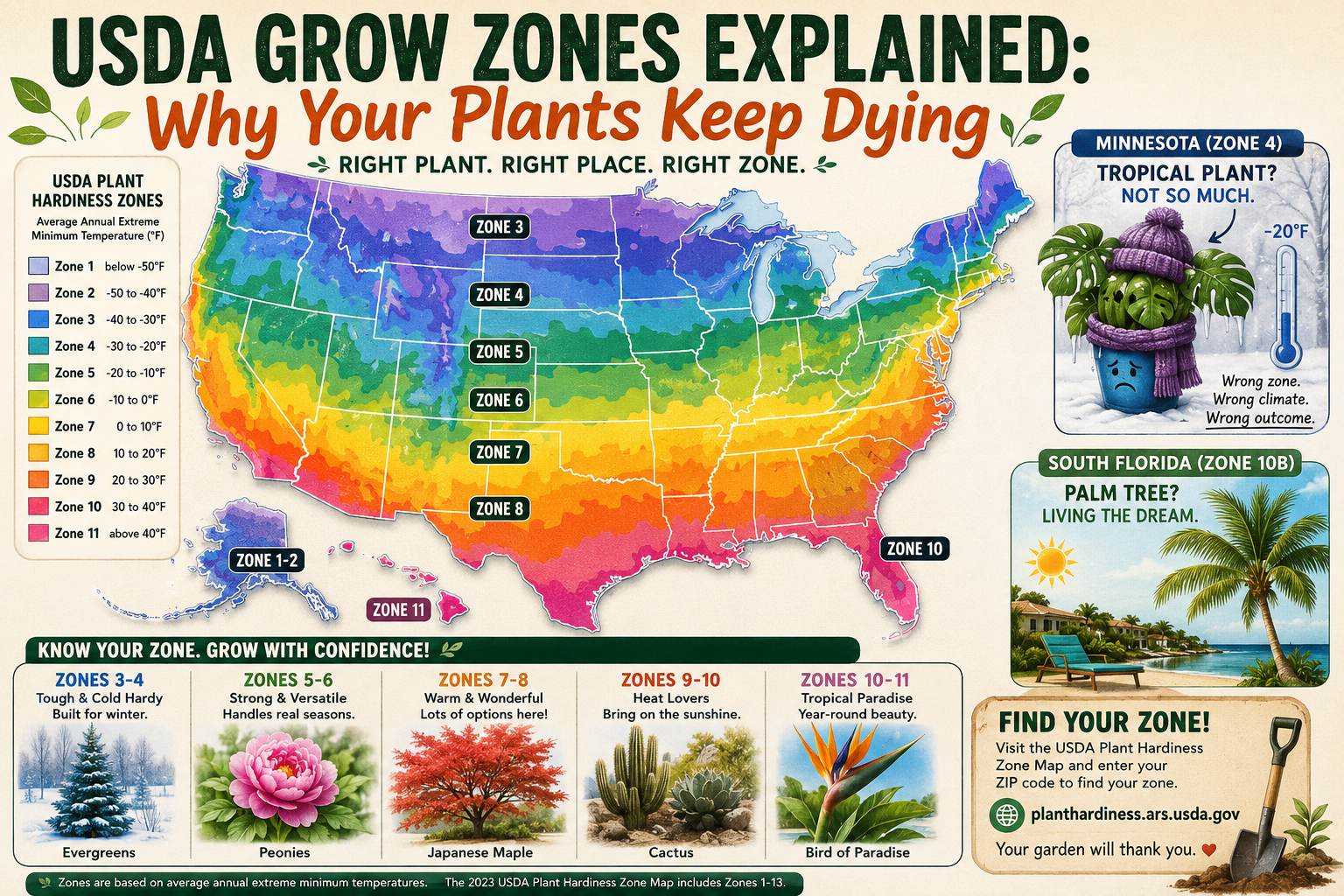
The USDA Plant Hardiness Zone Map divides the United States into regions based on average annual minimum winter temperatures. In other words, it tells you how cold your area typically gets during winter. Every plant has a temperature threshold where it essentially throws up its leaves and says, "I can no longer participate in this situation."
Some plants can survive temperatures well below zero. These plants are the gardening equivalent of people who wear shorts during snowstorms and claim they aren't cold.
Other plants begin to panic when temperatures fall below forty degrees. These are the botanical equivalent of Florida residents who wear winter jackets when the forecast reaches sixty-two.
The zone map helps match plants with the climates they can actually survive in.
A Tour Through America's USDA Growing Zones
One of the most fascinating things about the USDA Plant Hardiness Zone Map is that it tells the story of America's climate in a single glance. The map stretches from places so cold they make your freezer seem tropical all the way to regions where winter barely shows up for work.
Understanding these zones helps explain why certain plants thrive effortlessly in one location and fail spectacularly in another.
Zones 1 Through 3: Gardening on Expert Mode
The coldest USDA zones are found primarily in Alaska and the northernmost regions of North America. Zone 1 can experience temperatures below -50°F.
To put that in perspective, at -50°F most people stop worrying about their plants and start worrying about whether their eyebrows can survive the walk to the mailbox.
Gardeners in Zones 1 through 3 grow some of the toughest plants on Earth. These are plants that view snowstorms the same way most of us view a light spring drizzle. If you successfully garden in these zones, you deserve both admiration and a very sturdy winter coat.
Zones 4 and 5: Where Winter Still Runs the Show
Large portions of the northern United States fall into Zones 4 and 5. Winters are still harsh, but gardeners have a much wider selection of trees, shrubs, flowers, and vegetables available to them.
People who garden in these zones become masters of planning. They know their frost dates. They watch weather forecasts obsessively. They celebrate the arrival of spring with the enthusiasm usually reserved for championship sports victories.
After six months of snow and freezing temperatures, the appearance of a single flower bud can feel like a miracle.
Zones 6 and 7: The Gardening Sweet Spot
Many gardening experts consider Zones 6 and 7 to be ideal.
These zones offer enough winter chill for many fruit trees and perennials while still providing a long growing season. Gardeners can experiment with a huge variety of plants without constantly worrying about extreme cold or extreme heat.
This is where many gardeners begin believing they have a natural gift for growing things.
Sometimes they do.
Sometimes they're just lucky enough to live in a climate where nature is helping.
Zones 8 and 9: Long Growing Seasons and Happy Plants
Zones 8 and 9 cover much of the South, parts of Texas, California, and the Southeast.
These gardeners enjoy longer growing seasons, milder winters, and the ability to grow plants that northern gardeners often admire from afar. Camellias, gardenias, citrus trees, palms, and countless flowering plants thrive here.
Of course, weeds also thrive here.
Nature likes to keep things balanced.
Zones 10 and 11: Tropical Plant Paradise
If you've ever wondered where all those gardening magazine photos come from, there's a good chance the answer is Zones 10 and 11.
These warm regions include South Florida, the Florida Keys, Hawaii, and other tropical climates where freezing temperatures are rare.
Gardeners here can grow palms, bird of paradise, bougainvillea, hibiscus, citrus trees, and a host of other tropical plants year-round. Meanwhile, gardeners farther north spend winter carrying houseplants away from drafty windows and hoping they survive until spring.
It's enough to make a Zone 5 gardener a little jealous.
Why USDA Zones Matter So Much
One of the biggest mistakes new gardeners make is assuming every plant sold at a garden center can survive outdoors where they live.
This is not true.
Garden centers sell plants. They do not necessarily sell climate compatibility.
Before purchasing any tree, shrub, perennial, or outdoor plant, check the USDA zone listed on the tag. If a plant is rated for Zones 9 through 11 and you live in Zone 5, you're not buying a long-term landscaping solution.
You're buying a temporary outdoor decoration.
Knowing your grow zone won't solve every gardening problem. It won't stop overwatering. It won't improve poor soil. It won't keep squirrels from conducting unauthorized excavation projects in your flower beds.
What it will do is help you choose plants that actually belong in your climate.
And that simple piece of information can save you time, money, frustration, and countless future gardening disappointments.
Because successful gardening isn't about convincing a tropical plant to survive a Minnesota winter.
It's about finding plants that look at your local weather forecast and say, "Yeah, I can work with that."
Share on