

- House Plant Sitting
- June 15, 2026
- News
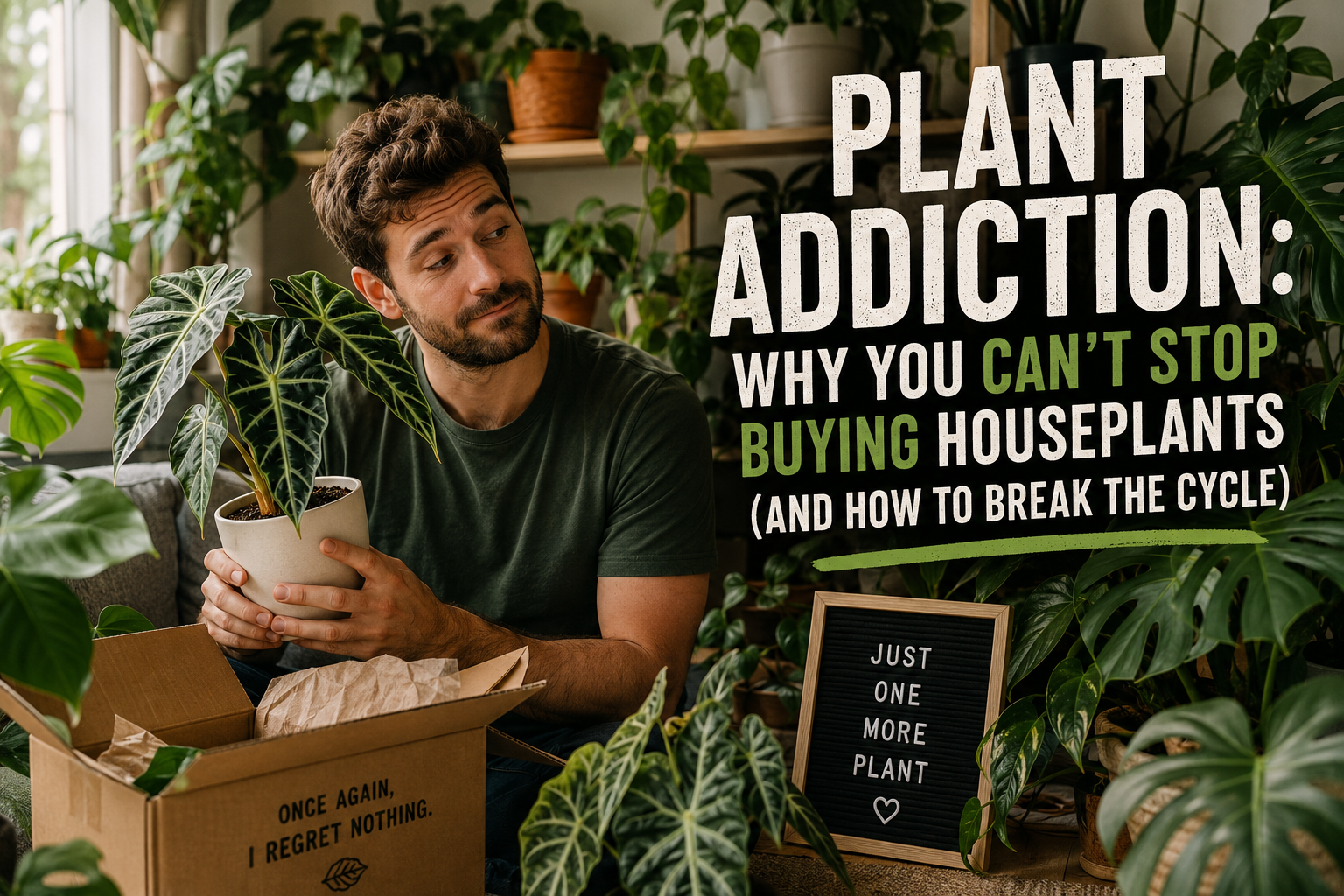
Plant Addiction: Why You Can't Stop Buying Houseplants (And How to Break the Cycle)
Plant Addiction: Why You Can't Stop Buying Houseplants (And How to Break the Cycle)
There comes a moment in the life of every plant lover when they stand in front of a newly purchased houseplant and ask an important question:
"Where exactly am I going to put this?"
This question is usually followed by another:
"Didn't I already buy one of these?"
And finally:
"Why am I carrying a six-foot tropical shrub into my house when I originally went to the store for paper towels?"
These are the kinds of questions that separate casual plant owners from people who have entered what scientists, psychologists, plant influencers, and spouses refer to as "The Situation."
The Situation occurs when a person develops the overwhelming urge to acquire more plants despite already possessing enough greenery to alter local weather patterns.
You may think this is an exaggeration.
It is not.
Some plant collectors have so many plants that if they disappear unexpectedly, authorities would need several days to determine whether they are actually missing or simply standing behind a giant monstera.
The strange thing is that most people with a houseplant addiction know exactly what is happening.
They know they have no room.
They know they already own twelve pothos.
They know they promised themselves they were finished buying plants.
Yet somehow, at 11:47 p.m., they are online staring at a rare variegated philodendron that costs approximately the same amount as a used refrigerator.
And they're thinking:
"Honestly, that's not terrible."
So why does this happen?
Why are people obsessed with buying plants?
Why do houseplants make us so happy?
And can plant collecting become an unhealthy obsession?
Let's investigate.
What Is Plant Addiction?
Before we begin, it's important to understand that plant addiction is not an official medical diagnosis.
You won't find "Houseplant Acquisition Disorder" listed in a psychology textbook.
Although if you spend enough time in plant Facebook groups, you'll discover there are people who strongly believe it should be.
When people talk about plant addiction, they're usually referring to compulsive plant buying, excessive plant collecting, or an inability to stop purchasing houseplants despite having more than enough already.
For many people, collecting plants is simply a healthy hobby.
They enjoy learning about different species.
They enjoy propagation.
They enjoy watching something grow.
They enjoy turning their home into what appears to be a tropical rainforest with electrical outlets.
Nothing wrong with that.
The issue begins when buying plants becomes more exciting than owning them.
When every stressful day results in another plant purchase.
When every rare plant release feels like an emergency.
When every paycheck mysteriously transforms into ceramic pots and grow lights.
At that point, the hobby may be evolving into something else.
And surprisingly, psychology has a lot to say about why this happens.
What Causes Plant Addiction? How Houseplant Obsession Begins
Nobody wakes up one morning and decides to own 400 plants.
Plant addiction begins innocently.
Almost suspiciously innocently.
Maybe somebody gives you a pothos.
Maybe you buy a snake plant because the internet claims it's impossible to kill.
Three weeks later you've somehow killed the snake plant.
This creates a feeling of unfinished business.
You decide you need another plant.
This one survives.
You feel successful.
A tiny burst of satisfaction appears in your brain.
Your brain enjoys this.
Your brain would like another burst.
Soon you buy a second plant.
Then a third.
Then a fourth.
At some point you discover that plants come in different varieties.
Then you discover there are rare varieties.
Then collector varieties.
Then imported varieties.
Then "limited edition" varieties, which is a phrase that should never be applied to something capable of reproducing itself.
But here we are.
Before long, you find yourself discussing leaf variegation with strangers on the internet.
At this stage, nature has found a direct route into your checking account.
The Science Behind Why Humans Love Plants
One reason houseplants are so appealing is that humans have spent most of history surrounded by nature.
For hundreds of thousands of years, our ancestors lived among trees, rivers, forests, and open landscapes.
Then we invented cities.
Now many people spend most of their lives surrounded by concrete, screens, traffic, fluorescent lighting, and emails marked "urgent."
This may explain why bringing plants into our homes feels so satisfying.
Researchers often refer to this as the biophilia hypothesis.
Biophilia suggests humans possess an innate desire to connect with nature and living things.
In simple terms:
Your brain likes plants because your brain evolved around plants.
When people add greenery to their living spaces, they often report feeling calmer, more relaxed, and more comfortable.
Even looking at plants can help create a sense of peace.
Which is fortunate, because many plant collectors spend large portions of the day staring at leaves and wondering whether they look slightly different than yesterday.
Why Buying New Plants Feels So Good
Most people assume plant addiction is about plants.
This is only partially true.
Plant addiction is really about anticipation.
Imagine what happens when you see a beautiful plant online.
Its leaves are perfect.
Its colors are stunning.
It has been photographed using lighting normally reserved for luxury sports cars and celebrity weddings.
Immediately your brain says:
"I need that."
The search begins.
You compare prices.
You watch videos.
You read care guides.
You check social media.
You join waitlists.
You perform enough research to qualify for a doctoral dissertation.
Finally, you buy the plant.
The package arrives.
You open the box.
For approximately 42 minutes, life is perfect.
Then something fascinating happens.
Your brain adapts.
The plant becomes part of your environment.
The excitement fades.
And another plant catches your eye.
This isn't because you're irresponsible.
It's because your brain loves novelty.
Human beings are essentially reward-seeking mammals wearing shoes.
We are wired to pursue new experiences.
The anticipation often becomes more rewarding than the actual possession.
This is one reason people continue buying plants even when their homes already resemble indoor jungles.
The Psychology of Plant Addiction and Dopamine
If you've ever wondered:
"Why can't I stop buying plants?"
The answer may involve dopamine.
Dopamine is often called the brain's reward chemical.
Many people mistakenly think dopamine is released after we get what we want.
In reality, dopamine is often strongest during anticipation.
The chase.
The possibility.
The expectation.
This means the most exciting part of plant shopping may not be owning the plant.
It may be searching for it.
Finding it.
Winning the auction.
Tracking the shipment.
Refreshing delivery updates every six minutes.
The plant itself eventually becomes familiar.
But the anticipation remains addictive.
This explains why some collectors experience a strange phenomenon.
They buy a plant they've wanted for months.
They feel thrilled.
Then, within days, they're already searching for the next one.
The cycle repeats because the hunt creates excitement.
The purchase creates relief.
And the anticipation begins again.
Why Houseplants Make People Happy
Here's the interesting part.
Plants genuinely do make people happy.
This isn't just marketing.
There are several reasons houseplants can positively affect wellbeing.
Plants create a sense of accomplishment.
Plants make indoor spaces feel more alive.
Plants provide opportunities for creativity.
Plants connect us with nature.
Plants encourage mindfulness.
Plants create routines.
And unlike many modern activities, caring for plants requires us to slow down.
A plant doesn't care about your notifications.
A monstera has never sent a passive-aggressive email.
A pothos has never scheduled a mandatory Zoom meeting.
Plants operate on plant time.
And plant time is significantly healthier than internet time.
Many people discover that watering, pruning, propagating, and observing plants becomes a peaceful ritual that helps reduce daily stress.
Can Houseplants Improve Mental Health?
One of the reasons houseplants have become so popular is their connection to mental health and wellbeing.
People often describe caring for plants as therapeutic.
And there may be good reasons for that.
Caring for plants encourages mindfulness.
Mindfulness simply means focusing on the present moment.
When you're repotting a plant, checking roots, pruning leaves, or watering a collection, your attention shifts away from work stress and endless digital distractions.
You become focused on a living thing directly in front of you.
For many people, this creates a calming effect.
Houseplants also provide visible progress.
In modern life, many accomplishments are abstract.
Emails disappear.
Meetings end.
Projects continue indefinitely.
But plants provide tangible evidence that your efforts matter.
You water them.
They grow.
You fertilize them.
They thrive.
You neglect them.
They stage a dramatic protest.
The feedback is immediate and honest.
Many therapists believe this sense of responsibility and accomplishment contributes to improved wellbeing.
Humans enjoy nurturing things.
We enjoy seeing progress.
Plants provide both.
Why Caring for Plants Feels Like Therapy
One reason plant therapy has become such a popular concept is that plants satisfy several psychological needs simultaneously.
First, they provide purpose.
Every plant requires some level of attention.
Even low-maintenance species depend on us.
This creates a healthy sense of responsibility.
Second, they provide routine.
Many mental health professionals emphasize the importance of routines.
Plants naturally encourage them.
Watering schedules.
Fertilizing schedules.
Repotting schedules.
Propagation projects.
These small rituals add structure to everyday life.
Third, plants provide positive reinforcement.
When you care for a plant properly, it rewards you with growth.
New leaves.
Flowers.
Roots.
Healthy foliage.
There is something deeply satisfying about helping another living thing thrive.
Especially when that living thing doesn't ask to borrow money.
For many people, plant care becomes a form of stress relief that feels meaningful, productive, and restorative.
The Hidden Connection Between Stress and Plant Shopping
Unfortunately, the same thing that makes plants therapeutic can also contribute to compulsive buying.
Life is stressful.
Work is stressful.
Finances are stressful.
The news exists.
Sometimes people simply want a small dose of happiness.
A new plant provides exactly that.
A plant represents hope.
Possibility.
Beauty.
Growth.
It represents a fresh start.
And unlike many expensive hobbies, buying a plant initially feels relatively affordable.
The problem occurs when purchasing plants becomes the solution to every unpleasant emotion.
Bad day?
Buy a plant.
Stressful week?
Buy a plant.
Argument with your boss?
Buy two plants.
Suddenly your emotional support system consists entirely of philodendrons.
That's a lot of pressure to place on a philodendron.
Even a really nice one.
Why Millennials and Gen Z Are Obsessed With Houseplants
Houseplants have become one of the defining hobbies of younger generations.
There are several reasons for this.
Many Millennials and Gen Z adults live in apartments without gardens.
Many move frequently.
Many rent rather than own homes.
Many work remotely.
Many spend enormous amounts of time indoors.
Houseplants solve several problems simultaneously.
They add beauty.
They improve aesthetics.
They provide a connection to nature.
They create a sense of ownership.
And unlike large furniture purchases, they are relatively affordable.
A beautiful plant can transform an entire room for the cost of dinner.
For younger generations facing rising housing costs and economic uncertainty, plants provide something valuable:
A living thing that grows because of your effort.
A source of stability.
Something you can take with you when everything else changes.
In an increasingly digital world, that connection feels meaningful.
Which may explain why millions of people now proudly identify as plant parents.
And why Instagram, TikTok, YouTube, and Facebook have become filled with plant collections, plant tours, plant hauls, propagation videos, and enough monstera content to fill several lifetimes.
Unfortunately, social media also creates a new problem.
And that problem is where plant addiction often accelerates.
How Social Media Turned Houseplants Into a Lifestyle
For most of human history, people owned plants for practical reasons.
Food.
Medicine.
Shade.
Oxygen.
The occasional attempt to keep goats from wandering into neighboring villages.
Then social media arrived.
Suddenly plants weren't just plants.
Plants became content.
A single search for houseplants, indoor plants, plant décor, plant styling, plant shelves, plant collections, rare plants, or "plant parent" content reveals millions upon millions of posts.
Entire social media accounts are dedicated to nothing but leaves.
Beautiful leaves.
Rare leaves.
Expensive leaves.
Leaves photographed with better lighting than most wedding portraits.
It's difficult to overstate how much social media has influenced modern plant culture.
Every day plant lovers see:
Massive plant collections.
Rare variegated specimens.
Perfectly staged indoor jungles.
Designer pots.
Propagation stations.
Plant haul videos.
Before-and-after transformations.
Plant room tours.
Suddenly a person who was perfectly happy with three houseplants starts wondering whether they should convert their dining room into a tropical conservatory.
This is where social comparison enters the picture.
And social comparison has been making humans miserable since the invention of other humans.
Plant FOMO: Why Houseplant Collectors Feel Pressure to Buy More Plants
Plant collectors suffer from a specialized form of FOMO.
Fear of missing out.
Normal people experience FOMO when friends attend concerts.
Plant people experience FOMO when someone on Instagram acquires a rare philodendron.
A plant becomes popular.
Everyone posts photos.
Everyone shares growth updates.
Everyone talks about how amazing it is.
The plant appears everywhere.
Suddenly it feels like the entire plant community belongs to an exclusive club.
A club that tragically does not include you.
Your brain begins creating scenarios.
"What if this plant disappears forever?"
"What if prices double?"
"What if I never get another chance?"
Historically, these thoughts were reserved for limited-edition sports cars, beachfront property, and winning lottery tickets.
Not decorative begonias.
Yet here we are.
The reality is that most plant trends come and go.
Plants that once sold for hundreds or even thousands of dollars often become widely available a few years later.
What seems rare today frequently becomes common tomorrow.
Unfortunately, logic rarely participates in FOMO.
Logic says:
"You already have 100 plants."
Emotion says:
"Yes, but not THIS one."
Emotion usually wins.
The Hedonic Treadmill and Why New Plants Stop Making You Happy
Psychologists use a term called the hedonic treadmill.
It sounds like exercise equipment designed by philosophers.
The idea is simple.
People quickly adapt to positive experiences.
You get something new.
You feel excited.
You enjoy it.
Then your emotional state gradually returns to normal.
This happens with cars.
Homes.
Phones.
Clothes.
And yes, plants.
You desire the plant.
You buy the plant.
You love the plant.
You adapt to the plant.
You desire another plant.
Repeat forever.
It's essentially the Circle of Life, except instead of lions and antelope it's shipping notifications and potting soil.
The more frequently this cycle occurs, the shorter the satisfaction period becomes.
Eventually the acquisition becomes more exciting than ownership.
That's often the moment people begin asking:
"Do I have a plant addiction?"
Is Plant Addiction a Real Thing?
Many plant lovers joke about being addicted to plants.
Most of the time they're joking.
Mostly.
However, compulsive buying behaviors can absolutely occur around hobbies.
The issue isn't the plant itself.
The issue is the pattern.
A healthy hobby typically adds value to your life.
A compulsive behavior often creates stress while simultaneously feeling difficult to stop.
Ask yourself:
Do plant purchases create financial strain?
Do they create guilt?
Do they create anxiety?
Do they create arguments with family members?
Do you feel relief immediately after purchasing a plant, only to repeat the process again shortly afterward?
If so, the issue may not be plants.
The issue may be using purchases to regulate emotions.
Plants simply happen to be the vehicle.
10 Warning Signs You Might Be Addicted to Buying Plants
How can you tell whether your plant hobby has crossed the line?
Here are some common warning signs.
1. You Hide Plant Purchases
If new plants enter the house through a secret entrance, additional investigation may be necessary.
2. You Lose Track of What You Own
You discover duplicates.
You don't remember buying either one.
3. You Need Inventory Software
Your collection requires spreadsheets.
Labels.
Maps.
Database management.
Possibly GPS tracking.
4. Watering Day Feels Like Military Logistics
You have schedules.
Zones.
Rotations.
Backup watering systems.
Emergency contingency plans.
5. Your Plants Outnumber Your Furniture
At some point your furniture becomes plant stands.
Every piece.
Without exception.
6. You Buy Plants Faster Than You Learn About Them
Research should ideally occur before acquisition.
Not three weeks afterward.
7. Your Budget Keeps Expanding
You started with a $10 pothos.
Now you're discussing imported collector specimens.
8. Looking at Your Collection Creates Stress
Plants should bring joy.
If they create overwhelm, something may need adjustment.
9. Every Emotion Triggers Plant Shopping
Happy?
Plant.
Sad?
Plant.
Bored?
Plant.
Hungry?
Possibly still plant.
10. You Feel Guilty After Every Purchase
This may be the most important sign.
Guilt often indicates a disconnect between what we want and what we believe is healthy.
Listen to that feeling.
It usually knows something important.
The Financial Cost of Plant Addiction
One reason plant addiction can sneak up on people is that individual purchases often seem small.
A $15 plant doesn't sound alarming.
Neither does a $20 plant.
Or a $30 plant.
Or a grow light.
Or a humidity cabinet.
Or imported soil.
Or decorative pots.
Or plant shelves.
Or propagation supplies.
Or another grow light because apparently the first one wasn't enough.
Individually these expenses seem harmless.
Collectively they can become substantial.
Many plant collectors eventually discover they haven't merely purchased plants.
They've purchased an entire ecosystem.
The plant itself is often the cheapest part.
This is why budgeting matters.
Not because plants are bad.
Because hobbies become much more enjoyable when they aren't creating financial stress.
Why More Plant Collectors Are Downsizing
Something interesting has happened over the last few years.
Many experienced collectors are reducing the size of their collections.
At first glance this seems strange.
After all, collecting traditionally involves accumulating more.
Not less.
But many plant owners eventually discover something surprising.
More plants does not automatically equal more happiness.
More plants means:
More watering.
More pests.
More repotting.
More maintenance.
More stress.
Eventually many collectors reach a point where quantity becomes exhausting.
Instead of chasing every new plant, they begin focusing on their favorites.
The goal shifts from acquisition to cultivation.
From collecting to caring.
From quantity to quality.
In many ways this represents the natural evolution of the hobby.
How to Stop Buying So Many Plants
If you feel your plant purchases are getting out of control, don't panic.
You don't need to sell everything and move into a plant-free apartment.
The goal isn't to stop loving plants.
The goal is to develop a healthier relationship with buying them.
Create a Waiting Period
This may be the most effective strategy available.
See a plant you want?
Wait 24 hours.
Or 48 hours.
Or a week.
Many urges disappear when given time.
Plant marketers would strongly prefer you never discover this information.
Unfollow Trigger Accounts
Not every plant influencer is bad.
But if certain accounts consistently make you want to spend money, consider reducing exposure.
Out of sight often means out of cart.
Inventory Your Collection
Many people are shocked when they actually count their plants.
Some discover they already own multiple versions of what they were planning to buy.
Focus on Growth Instead of Acquisition
Challenge yourself to grow existing plants larger.
Healthier.
More beautiful.
The satisfaction can be surprisingly rewarding.
Learn Propagation
One of the best ways to enjoy new plants without buying them is creating them yourself.
Propagation satisfies the desire for something new while costing very little.
Plus it makes you feel like a wizard.
The 30-Day Plant Buying Detox Challenge
If you're serious about breaking the cycle, try this challenge.
Week 1: No Plant Purchases
Simple.
No buying.
No browsing.
No plant auctions.
No "just looking."
Week 2: Inventory Everything
Count your plants.
Photograph them.
Create a list.
Most people discover they own more than they realized.
Week 3: Improve Existing Plants
Repot something.
Clean leaves.
Address pests.
Rotate growth.
Focus on care rather than acquisition.
Week 4: Reevaluate Your Wishlist
Look at the plants you wanted a month ago.
Do you still want them?
Many people discover the answer is no.
That's valuable information.
Healthy Alternatives to Compulsive Plant Shopping
One reason plant buying becomes habitual is that it fills emotional needs.
The solution isn't removing plants.
It's expanding your sources of fulfillment.
Try:
Reading.
Exercise.
Painting.
Photography.
Swimming.
Travel.
Learning new skills.
Volunteering.
Spending time with friends.
Plant swaps.
Plant care projects.
Plant journals.
Plant photography.
The broader your life becomes, the less pressure any one hobby has to carry.
And frankly, that's a lot to ask of a philodendron.
Frequently Asked Questions About Plant Addiction
What is a plant addiction called?
There is no official diagnosis called plant addiction. It is usually referred to as compulsive plant buying, houseplant addiction, plant obsession, or excessive plant collecting.
Why am I obsessed with buying plants?
People often become obsessed with buying plants because new purchases trigger excitement, anticipation, novelty, and reward pathways in the brain.
Can buying plants become an addiction?
While not a formal addiction, buying plants can become compulsive if it creates financial problems, stress, anxiety, or feels difficult to control.
Why do plants make people happy?
Plants connect us with nature, provide a sense of accomplishment, improve indoor aesthetics, and encourage mindfulness.
Are houseplants good for mental health?
Many people find that caring for houseplants reduces stress, creates calming routines, and provides a sense of purpose and achievement.
Why do Millennials and Gen Z love houseplants?
Houseplants offer affordable décor, connection to nature, creative expression, and companionship in an increasingly digital and urban world.
How do I stop buying so many houseplants?
Waiting before purchases, creating a budget, focusing on plant care, reducing social media triggers, and learning propagation are all effective strategies.
Can too many houseplants cause stress?
Absolutely. A collection that becomes overwhelming can create maintenance fatigue, anxiety, and financial strain.
Is plant collecting a healthy hobby?
Yes. For most people, plant collecting is a healthy, relaxing hobby that promotes learning, creativity, and connection with nature.
How many houseplants are too many?
The answer varies for each person. If your collection creates more stress than enjoyment, you've likely exceeded your ideal number.
Try to Love Growing Plants More Than Buying Them
Because at the end of the day, the best part of plant ownership isn't buying a plant.
It's watching it grow.
It's seeing a new leaf unfurl.
It's noticing roots develop.
It's witnessing something alive thrive because of your care.
That kind of satisfaction is slower.
Quieter.
Less dramatic.
It doesn't arrive in a shipping box.
It won't generate thousands of likes on social media.
And it certainly won't trigger the same rush as finding a rare collector specimen at midnight.
But unlike the excitement of a purchase, it lasts.
The irony of plant addiction is that many people enter the hobby because they love plants, then gradually become more focused on buying them than growing them.
The happiest plant owners eventually discover a different path.
They stop chasing every new release.
They stop comparing collections.
They stop treating plants like trophies.
Instead, they focus on cultivation.
Observation.
Patience.
Growth.
Not just the plant's growth.
Their own.
And if you're lucky, that shift reminds you why you fell in love with houseplants in the first place.
Not because you wanted more plants.
But because you loved watching them grow.
Share on